 Reload Image or
Why Vincent Vacations Has the Best Travel Agents for South Africa
When you close your eyes and imagine Antarctica, what do you see?
Do you see yourself standing on a rocky beach, surrounded by thousands of King Penguins while a glacier calves into the sea just yards away? Or do you see yourself standing on a balcony on the 14th deck of a floating hotel, looking at those penguins through binoculars while sipping a latte?
Both are valid ways to visit the White Continent. But unfortunately, many travelers book the latter expecting the former.
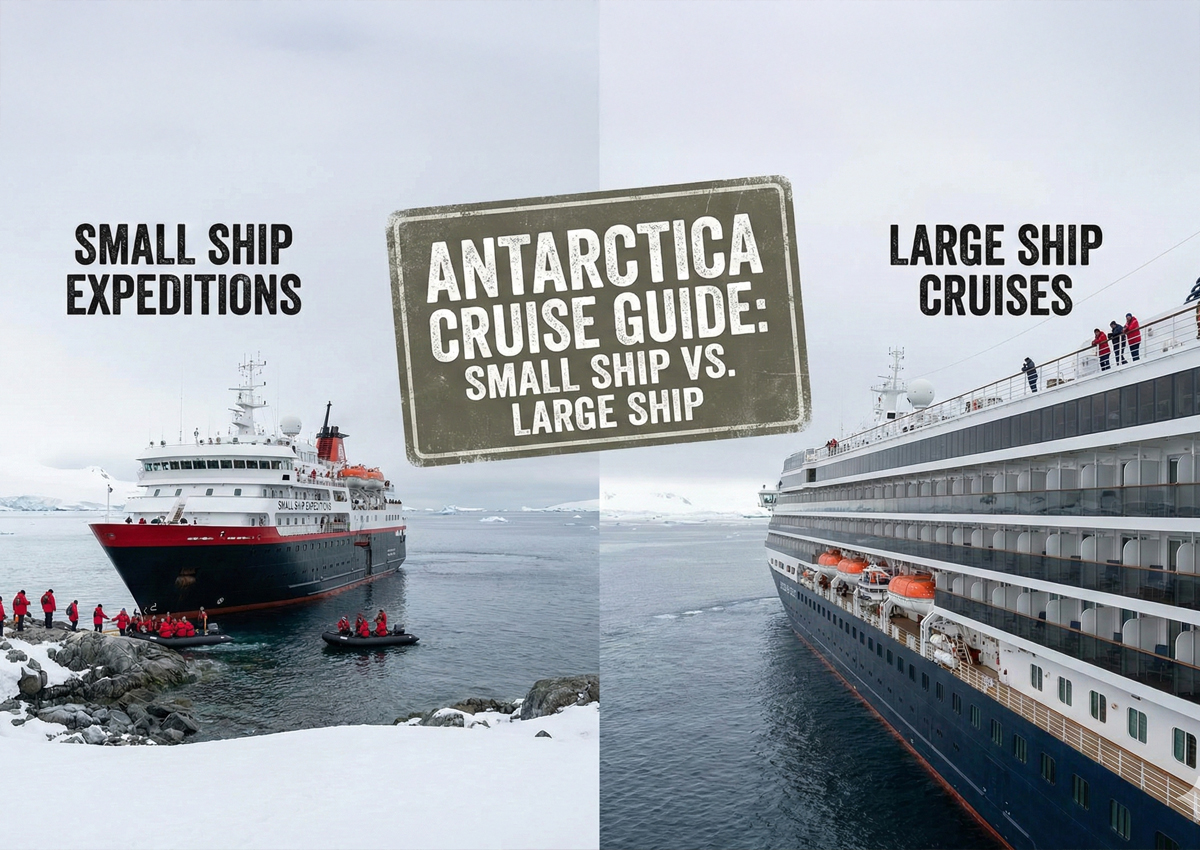
The single most critical decision you will make when booking a trip to Antarctica is not the month you go, or even the price you pay. It is the size of the ship. Ship size determines everything: where you can go, how long you can stay, and—most importantly—whether you are actually allowed to get off the boat.
As proud members of the Signature Travel Network, we have access to the world’s most vetted portfolio of Antarctic suppliers. We know the difference between a “cruise” and an “expedition.” This guide will break down the crucial differences so you can invest in the experience that matches your dreams.
The “500 Passenger Rule”: What You Need to Know
Before we discuss specific cruise lines, we must address the most important regulation in polar travel.
The International Association of Antarctica Tour Operators (IAATO) creates the guidelines that protect the Antarctic environment. Their rules are strict, and they apply to every single operator.
The Golden Rule:
Ships carrying more than 500 passengers are NOT allowed to land passengers in Antarctica.
If you book a ship with 501 people on board, you will not set foot on the continent. You will not hike a glacier. You will not walk among the penguins. You will remain on the ship the entire time.
Furthermore, for ships that do carry fewer than 500 passengers, only 100 passengers are allowed on shore at any one time. This logistical bottleneck is why ship size matters so much. A ship with 400 people must rotate them in four separate groups. A ship with 100 people can arguably have everyone on shore at once (or in Zodiacs) for longer durations.
The “Scenic Only” Experience (Large Ships)
Who are these for?
These voyages are best for travelers who have severe mobility issues, travelers on a tighter budget, or those who simply prefer the amenities of a mega-resort (casinos, Broadway-style shows, multiple specialty restaurants) over the destination itself.
The Major Players:
-
Celebrity Cruises
-
Princess Cruises
-
Holland America Line (HAL)
The Experience
On these voyages, you are technically visiting Antarctica, but you are doing so from a distance. These are often referred to as “Drive-by” or “Scenic Cruising” voyages.
The ship will sail through the Drake Passage and enter Antarctic waters. You will see magnificent icebergs, massive glaciers, and whales from the deck. The captain will navigate through scenic channels (like the Neumayer Channel) if weather permits.
However, the experience is passive. You are a spectator. You cannot take a Zodiac cruise to get closer to a leopard seal on an ice floe. You cannot step onto the land. For many, the price point (often significantly lower than expedition cruises) makes this attractive, but it is vital that you understand the limitation before you pay.
Pros:
-
Significantly lower cost.
-
Familiar “big ship” amenities (large casinos, entertainment).
-
Greater stability in the Drake Passage due to massive ship size.
Cons:
-
Zero landings. You do not walk on Antarctica.
-
You miss the sensory details: the smell of the penguin colonies, the sound of the ice crackling, the spray of the water.
The “Expedition” Experience (Small Ships)
Who are these for?
These are for travelers who want to be participants rather than spectators. If your goal is to set foot on the 7th Continent, hike, kayak, or camp, you must book an expedition ship.
Expedition ships are designed specifically for polar waters (Ice Class hulls). They carry fleets of Zodiacs (heavy-duty inflatable boats) and kayaks. Instead of a Cruise Director, the most important person you’ll meet is the Expedition Leader, who manages a team of naturalists, biologists, geologists, and historians.
We categorize our preferred expedition partners into two distinct groups: Pure Expedition and Luxury Expedition.
Category 1: Pure Expedition
Focus: Adventure, Science, Education, and Authenticity.
These lines prioritize the destination above all else. While the ships are comfortable (and often quite new), the luxury lies in the access and the expertise of the team.
Quark Expeditions
-
Best For: Hardcore polar enthusiasts and “Fly-Cruise” options.
-
Why We Love Them: Quark focuses exclusively on polar regions; they don’t do Caribbean cruises in the off-season. They are pioneers in “Fly-Cruise” itineraries, where you fly over the Drake Passage to King George Island and board the ship there, skipping the rough seas entirely.
-
The Vibe: Their new ship, the Ultramarine, features two twin-engine helicopters, offering Heli-hiking and flightseeing—a game changer for perspective.
Lindblad Expeditions
-
Best For: Education, National Geographic photography, and science.
-
Why We Love Them: The alliance between Lindblad and National Geographic is legendary. You aren’t just going on vacation; you are joining a floating university. The photography instructors on board are often Nat Geo certified, helping you capture professional-grade images.
-
The Vibe: Deeply intellectual and curious. Expect data collection for citizen science projects and divers who go underwater to film the sea floor, showing you the footage during dinner.
Hurtigruten / HX
-
Best For: Heritage, sustainability, and a “Base Camp” feel.
-
Why We Love Them: With over a century of polar heritage, they know these waters. They have heavily invested in green technology, with hybrid-electric ships like the MS Roald Amundsen.
-
The Vibe: Their concept of “Expedition as a Base Camp” makes the ship feel like a comfortable lodge from which you launch adventures. It is less about white-glove service and more about rugged, authentic capability.
Category 2: Luxury Expedition
Focus: The “White Lotus” on Ice. Adventure by day, Michelin-star dining by night.
For a long time, you had to choose between luxury and expedition. Not anymore. These lines offer “soft adventure” without compromising on 5-star amenities.
Silversea Expeditions
-
Best For: Door-to-door all-inclusive luxury and smaller ships.
-
Why We Love Them: Silversea is arguably the most inclusive line in the world. Their “Door-to-Door” fare includes a private executive car transfer from your home to the airport, your flights, hotels, and the cruise.
-
The Vibe: Butler service for every suite. After a freezing landing, a butler is waiting to take your parka and hand you a glass of champagne. Their ships like the Silver Endeavour are purpose-built for high-ice class but feel like a Ritz-Carlton inside.
Ponant
-
Best For: French luxury and icebreaker capabilities.
-
Why We Love Them: Ponant brings a distinct “French touch” to the poles (think Ducasse counselled menus and Ladurée macarons). However, their crown jewel is Le Commandant Charcot.
-
The Vibe: Le Commandant Charcot is the world’s only luxury icebreaker (PC2 Class). While other ships must skirt around thick sea ice, the Charcot can plow right through it. This allows it to reach areas of the Weddell Sea and Peter I Island that no other passenger ship can reach.
Seabourn
-
Best For: Ultra-luxury service and submarines.
-
Why We Love Them: Seabourn is renowned for intuition—service that knows what you want before you ask. Their expedition ships (Venture and Pursuit) carry two custom-built submarines.
-
The Vibe: Descending 1,000 feet below the Antarctic surface in a submarine is a life-altering experience. Combining this with Seabourn’s caviar-in-the-surf style of luxury makes for an unmatched vacation.
Viking Expeditions
-
Best For: Nordic comfort and “The Hangar.”
-
Why We Love Them: Viking has revolutionized the “launch” process. Their expedition ships feature “The Hangar,” an enclosed, in-ship marina. You step into a Special Operations Boat (SOB) inside the ship, and it slides out into the water.
-
The Vibe: No swaying on a gangway in wind trying to board a Zodiac. It is safe, civilized, and distinctly Scandinavian. Their “Aula” theater offers floor-to-ceiling windows for lectures with a view.
Comparison Table: Choosing Your Ship
The Signature Travel Network Advantage
You might be tempted to book directly with a cruise line, but here is why booking through our agency—a proud member of the Signature Travel Network—is the smarter choice.
-
Buying Power & Perks: Because we are part of a massive network, we often have access to exclusive rates and perks you cannot find online. This often includes Shipboard Credits (free money to spend on spa treatments or excursions), complimentary private transfers, or prepaid gratuities.
-
Vetted Suppliers: We don’t just sell cruises; we vet operators. If a supplier has a history of engine trouble or poor safety records, we know about it, and we steer you clear.
-
Advocacy: In the rare event that flights are cancelled or connections are missed, you have us in your corner. We have direct lines to the sales VPs of these companies. You aren’t just a confirmation number to us; you are a client.
Frequently Asked Questions (FAQ)
Q: Is the Drake Passage really that bad? A: It can be. The “Drake Shake” is real, with swells that can reach 20+ feet. However, it can also be the “Drake Lake.” Modern expedition ships are equipped with advanced stabilizers that significantly reduce motion. If you are terrified of seasickness, ask us about Quark’s “Fly-Cruise” options that skip the boat ride across the passage entirely.
Q: How fit do I need to be for an Expedition cruise? A: You do not need to be an athlete, but you should be able to walk up and down stairs and have enough balance to step from a ship into a moving Zodiac boat. The crew is highly trained to assist you with the “sailor’s grip,” ensuring you transfer safely.
Q: What is included in the price? A: Expedition cruises have a higher upfront sticker price ($10,000 – $20,000+ pp), but they are highly inclusive. Almost all include daily excursions, landings, gear (parkas are usually yours to keep; boots are rented/loaned), meals, and often alcohol. When you factor in the value, the price gap with large ships narrows.
Q: When should I book? A: Antarctica has a very short season (November to March). Because the best ships have fewer than 200 suites, they sell out 12 to 18 months in advance. To get your preferred cabin on a specific date, you need to plan ahead.
Ready to Plan Your Expedition?
Antarctica is not a trip you book on a whim. It is an investment in memories that will last the rest of your life. Whether you want the raw adventure of Lindblad, the submarine thrills of Seabourn, or the ice-breaking power of Ponant, we can guide you to the right ship.